

The Complete Guide to Employee Performance Tracking in 2026
You promoted the wrong person. You found out three months later when the team started quitting.
The signs were there. Missed commitments buried in email threads. Slow responses to customer messages. Credit-taking in Slack while teammates did the actual work. You just never saw it.
Hybrid work didn’t create this blind spot. It revealed how little visibility you ever had.
A 2024 Gallup study found that 77% of employees are disengaged, costing U.S. companies up to $500 billion per year in lost productivity. The problem isn’t effort. It’s that leaders are making million-dollar people decisions based on meeting behavior and gut instinct.
In 2026, you need evidence, not impressions. Weekly scorecards showing who responded, who followed through, and who let things slip. Actual messages with timestamps, not annual reviews based on memory. In short, you need an always-on retrospective.
Read this article so you can build an employee performance tracking framework that shows you the truth about your team before you lose your best people or promote your worst.
What Employee Performance Tracking Means Today
For decades, performance tracking meant annual reviews, reliance on impressions, and lack of objective evidence. Managers formed opinions based on who spoke confidently, who stayed late, and who seemed productive.
Today, work happens through email, Slack, video calls, and inside disparate project tools which often times do not “talk to each other” in a meaningful way. Modern employee performance tracking must address missed emails, slow replies, and toxic behaviors.
This is what is needed – and currently unavailable in any tool other than PerformanceX.
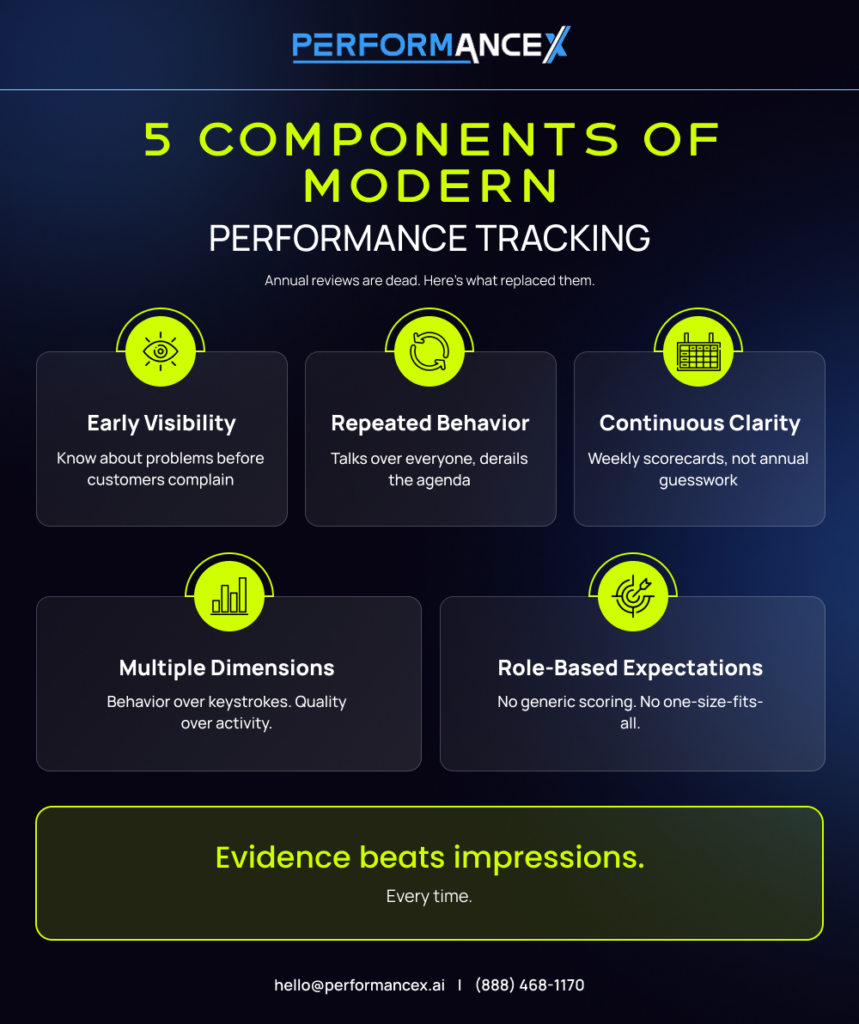
1. Early Visibility
If a customer email sits unanswered for two days, you need to know before the customer complains. PerformanceX analyzes communication and flags problems so leaders can act before customers feel them.
2. Multiple Dimensions of Behavior
Mouse clicks and keyboard activity don’t show performance. Real performance shows up in communication quality, reliability, responsiveness, professionalism, collaboration, and follow-through on commitments. A single metric never tells the truth. Behavior does.
3. Repeated Behavior, Not Exceptions
One delayed reply means nothing. Repeated delays across weeks reveal who someone really is. One tense message might not matter. Repeated deflection, slow replies, or unhelpful language shows something deeper. PerformanceX identifies repeated behavior across messages and calls so leaders see what actually happens between meetings.
4. Role-Based Expectations
A salesperson, an account manager, a support rep, and a project lead all require different standards. Employee performance tracking must adapt to expectations defined for each role. PerformanceX evaluates employees against role expectations and communication evidence. No generic scoring. No one-size-fits-all.
5. Continuous Clarity Instead of Annual Reviews
This is clarity, not micromanagement. Weekly scorecards show employees exactly what they did well and what they need to improve. Each insight includes a real message or call with a timestamp. Evidence reduces misunderstandings. Politics take a back seat because the evidence is objective.
Why Traditional Tools Fail
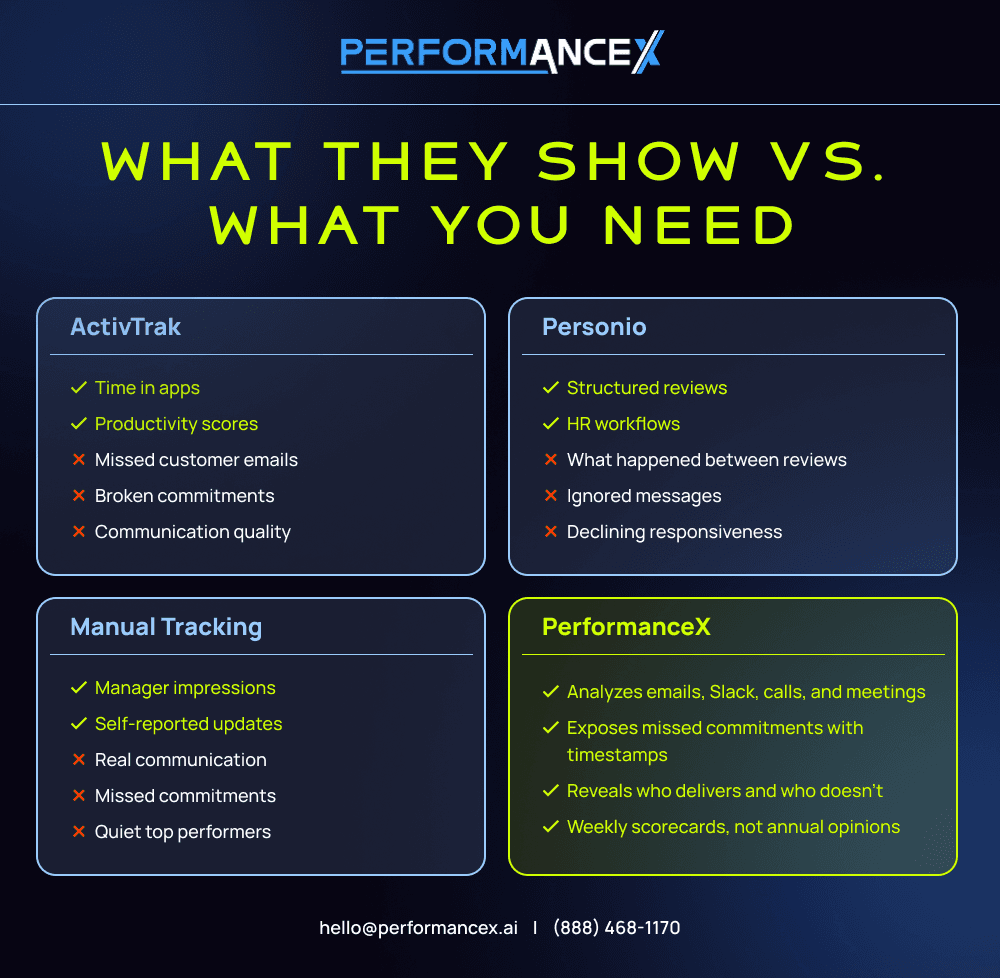
Most tools were designed to track activity, manage schedules, or create structured review cycles. They show hours worked or tasks assigned, not the messages that were ignored, the commitments that slipped, or the customer who got frustrated. This is why leaders miss the problems that matter most. Activity tools measure motion through different project stages. PerformanceX shows behavioral evidence.
So what are the top performance management tools on the market today delivering?
ActivTrak
ActivTrak shows time in apps and general productivity. It doesn’t show whether a customer was left waiting, whether a commitment slipped, or whether an employee created friction in their communication. Activity trackers focus on motion. PerformanceX focuses on behavioral evidence: how people respond, collaborate, and follow through.
Personio
Personio offers structured reviews and HR workflows. These help organize conversations, but they don’t reveal what employees did in the days and weeks between those conversations. They don’t show ignored messages, missed commitments, or declining communication quality. PerformanceX brings the evidence behind those moments, tied to timestamps and the role expectations you define.
PeopleManagingPeople
PeopleManagingPeople provides management advice, templates, and frameworks. Useful for theory. But theory doesn’t show how employees behave with customers, teammates, or deadlines. It cannot reveal slow replies, excuse-making, or the small breakdowns that grow into real problems. PerformanceX reads your communication tools and shows what’s been happening all along.
Manual Tracking Hides the Truth
Even without these tools, manual employee performance tracking fails for three reasons:
- Memory is unreliable.
- Managers remember the dramatic moment, not the consistent performer.
- They reward the person who talks the most, not the one who delivers.
Visibility is limited. Leaders see curated updates and self-reported wins. They rarely see the messages, decisions, and missed commitments that reveal who makes an impact.
Annual reviews reward confidence, not performance.
The person who speaks well in meetings gets the credit. The quiet collaborator doesn’t. Promotions reflect personality and visibility instead of the work that moved the business forward.
The Difference
Older tools highlight activity or structure. They help you talk about performance. PerformanceX shows the communication behavior linked to role expectations, so leaders can act with evidence instead of guesswork.
The PerformanceX Approach to Employee Performance Tracking
The evidence you miss can destabilize your business. A customer leaves, a top performer resigns, or a project falls apart. Then you can pinpoint the problem. But it was already visible in communication, follow-through, and day-to-day behavior. You just didn’t have a way to see it.
PerformanceX analyzes and monitors the messages, calls, and interactions that already happen inside your organization.
Our AI evaluates communication behavior against the expectations you define for each role. You see the exact email that frustrated a customer. You get an alert when someone makes a commitment and fails to deliver. You see who responds constructively and who delays or deflects.
PerformanceX doesn’t guess about intent. It shows communication with timestamps, organized so leaders can act. When the same missed follow-throughs recur week after week, they become apparent. When someone consistently collaborates, it’s no longer hidden.
This is the Always-On Retrospective. Instead of relying on impressions or once-a-year feedback, you get weekly evidence about how employees communicate, follow through, and collaborate. Leaders interpret the data. PerformanceX gives you the clarity to make the right decisions.
How to Build a Scalable Performance Tracking Framework
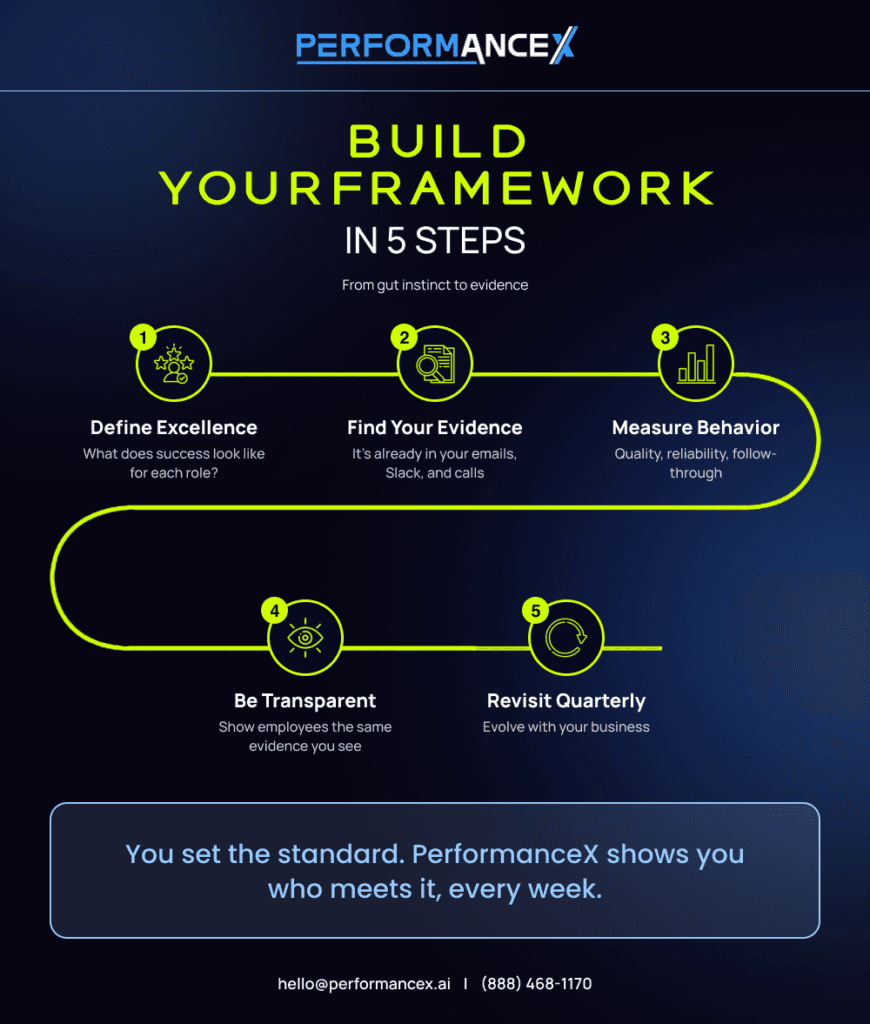
Every organization can build a clear view of how employees actually work. This requires a consistent way to evaluate communication, reliability, and follow-through so leaders can act on evidence instead of assumptions. Follow these five steps.
Step 1: Define Excellence by Role
Excellence must be clear, specific, and tied directly to responsiveness, clarity, and follow-through. Define what strong communication looks like, what reliable execution looks like, and which responsibilities indicate success for each role.
When expectations are documented and practical, employees know how to perform and managers know how to evaluate. This creates a fair, consistent foundation that PerformanceX measures against real communication.
Step 2: Accept That You Already Have the Evidence
Your organization already produces the communication leaders need to evaluate performance. Emails, messages, calls, and notes reveal who responds quickly, who ignores customers, and who fails to fulfill commitments. The problem isn’t lack of data. It’s lack of visibility.
PerformanceX connects to the tools where work happens and organizes communication and follow-through evidence into clear weekly scorecards that show what each employee actually did.
Step 3: Build a Multi-Dimension Approach
Employee performance tracking requires evaluating the behaviors and outcomes that move the business forward. Measure communication quality, reliability, customer interaction, and internal coordination.
When these layers work together, they reveal who helps the team succeed and who dodges accountability. Avoid vanity metrics or activity counts. Focus on behaviors that affect customers and team execution.
Step 4: Roll Out With Transparency
Transparency removes fear and reduces speculation. Tell employees what you measure, how you evaluate behavior, and why these standards matter.
Walk them through how their scorecards work so they can see the evidence. When people understand expectations and see that evaluations are tied to their own messages and responsibilities, performance becomes a fair and predictable process rather than a political one.
Step 5: Revisit Quarterly
A strong framework must evolve with your business. Review your expectations every quarter to confirm they match your team needs, customer demands, and organizational priorities.
Look at trends from weekly scorecards to identify which behaviors work and which standards need refinement. Adjust as needed so your framework stays relevant and practical.
Consistent review keeps your employee performance tracking operation aligned with real outcomes and strengthens accountability across the team.
The Future of Performance Tracking
Early Behavioral Warning
The next era of performance visibility is already unfolding. We are the living proof of it!
- Early Behavioral Warning AI identifies shifts in communication before customers or teammates feel them.
- Behavior-Based Progression Promotions and advancement will be tied to documented behavior, not tenure or politics.
- Automated Documentation Weekly reports, PIP monitoring, and behavior summaries will be generated without manual review.
- A More Predictable Culture Employees understand how performance is evaluated and why. Results improve because expectations are clear.
PerformanceX is building this future. Leaders see who performs, who struggles, and who may be disengaging, supported by evidence they can trust.
Track Real Performance, Not the Meeting Version
Are you making decisions based on evidence or impressions?
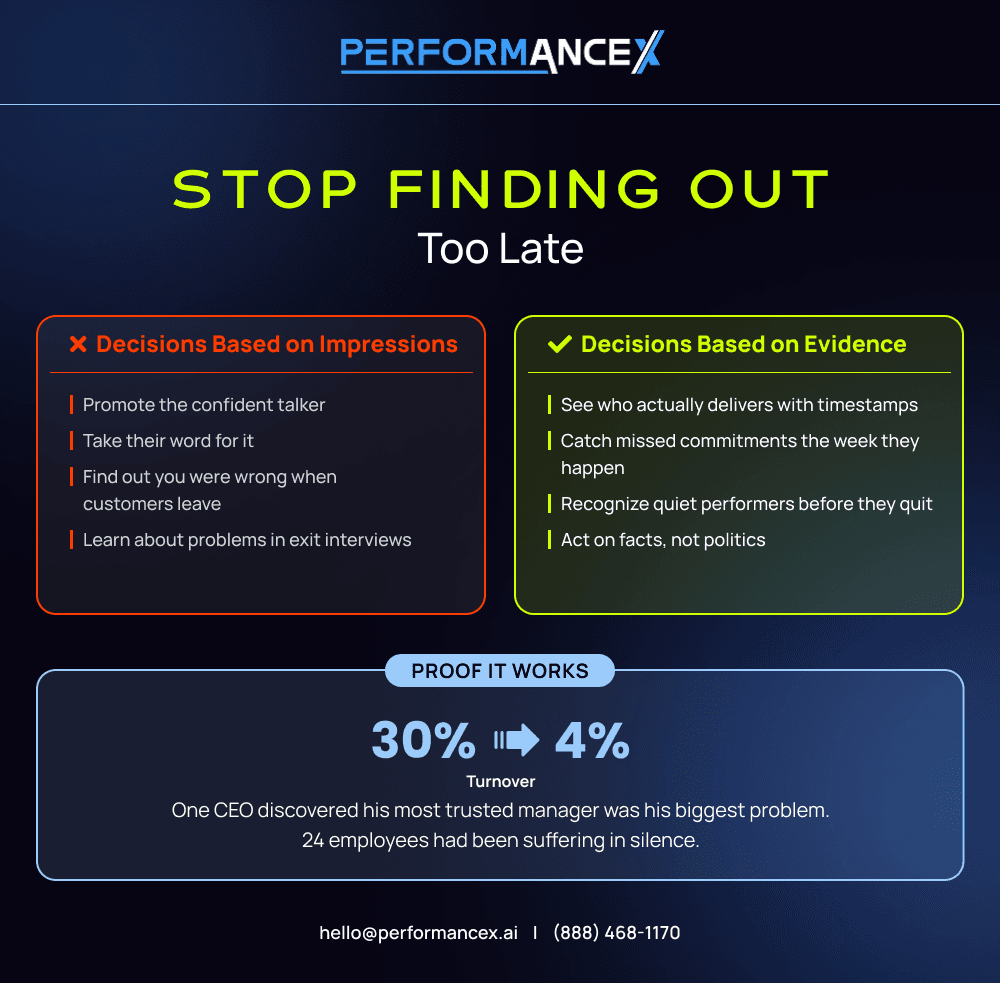
Most leaders rely on impressions. These are the most common scenarios:
- They promote the confident talker.
- They trust the person who gives polished updates.
- They find out they were wrong when customers leave, projects fail, or top performers quit without warning.
This article gave you the blueprint for a much better and more effective approach:
Define what excellence looks like for each role. Track the communication behaviors that actually matter: responsiveness, reliability, follow-through, and collaboration. Build transparency so employees see the same evidence you do. And replace annual reviews with weekly scorecards that show what really happened.
PerformanceX makes this possible.
Every Monday at 6AM, you get a report with names, quotes, and timestamps. You see who delivered and who didn’t. You see the missed customer email, the excuse-making in Slack, the commitment that never got fulfilled. No guessing. No politics. Just evidence.
Your best performers deserve to be recognized. Your worst shouldn’t be able to hide. That’s what real employee performance tracking looks like.
Name one top performer and one employee you’re worried about. We’ll analyze their last twelve months of communication and deliver a detailed report within 48 hours.
Start your 48-Hour Proof Analysis now.