

You already know who they are. The one who complains in every meeting. The one who blames everyone else when deadlines slip. The one who creates conflict that brings the whole team down.
Toxic coworkers cost you clients, talent, and execution long before anyone files a complaint.
In a 2023 survey, the American Psychological Association found that 19% of employees viewed their workplace as at least somewhat or very toxic. Learning how to deal with toxic coworkers is crucial for protecting execution and keeping your best people.
Read this article so you can spot it, document it, and stop it before your best people leave.
Spotting Toxic Behavior Before It Slows Down Your Team
Toxic coworkers exhibit consistent negative behaviors that harm others and the company. First, identify what makes a coworker toxic and how their behavior affects your team. Managing toxic coworkers starts with recognizing who they are.
Reduced productivity costs U.S. organizations an estimated $2 billion every day, and work slows down long before a complaint appears. By identifying the warning signs early, you can address workplace behavioral challenges before they escalate. Below are some common toxic employee signs and how they undermine healthy team dynamics:
- Blame-Shifting: Dodging responsibility in Slack or email, blaming coworkers for work they were assigned, or denying work commitments that are documented in writing.
- Meeting Hijacking: Talking over teammates, derailing agendas, or dominating discussions to avoid accountability.
- Passive Resistance: Agreeing in meetings, then ignoring tasks, delaying responses, or quietly withholding follow-through in day-to-day communication.
- Aggression Disguised as Directness: Using hostile, sarcastic, or intimidating language in messages or calls, then claiming “I’m just being direct.”
- Client Neglect / Internal Neglect: Letting emails sit unanswered, ignoring co-worker requests, or failing to acknowledge responsibilities that affect teammates’ work.
- Credit Theft: Taking ownership of work done by others, minimizing others’ contributions, or inserting themselves into conversations only when outcomes look favorable.
These problems stem from specific behaviors, not personality traits. When these behaviors occur repeatedly, you cannot ignore them or hope they will resolve on their own.
Recognizing these behaviors early is the foundation for dealing with toxic coworkers, as it allows you to act before conflict escalates and before the team’s trust or execution breaks down.
How Others Frame Toxic Employee Management
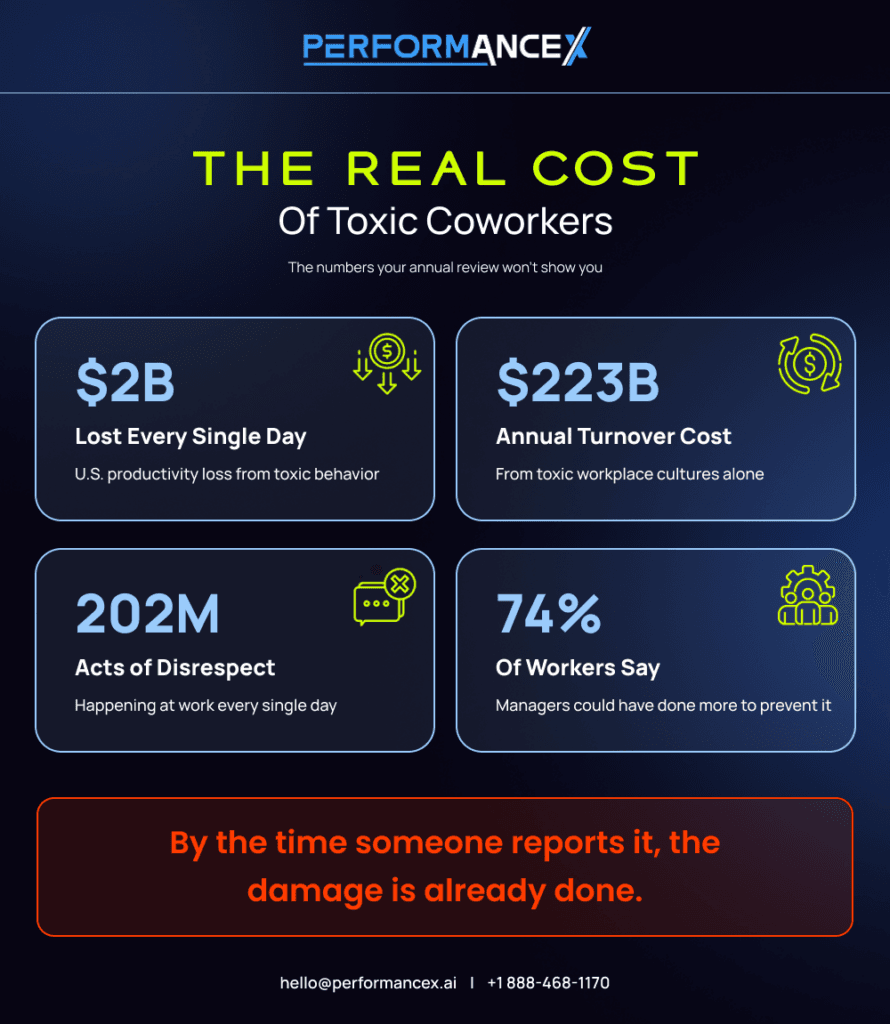
One toxic employee costs more than two or three top performers combined. With $223 billion lost each year to toxic workplace turnover, leaders cannot afford to track performance on gut instinct
Culture beats raw talent. Many organizations describe destructive behavior in broad terms, so understanding how they talk about it helps you set a higher standard grounded in evidence instead of opinions:
- Zero Tolerance vs. High-Output Employees Who Damage Teams: Most leaders agree on one thing: toxic employees cost more than they deliver. A high performer who regularly creates conflict or undermines coworkers becomes a net negative to your bottom line. More leaders are making the same call: protect the team, not the top performer who damages it.
- Retention and Cost Concerns: Competing HR organizations often frame toxic employee management as a retention and cost issue. Toxic behavior from coworkers can drive top employees out of their jobs. You cannot keep good people if you tolerate bad ones.
- Approaches in Practice: Organizations describe their approaches in different ways, but most act early, set clear policies, then guide employees toward improvement or toward the exit. Swift action is crucial, whether through training or termination. Dealing with toxic coworkers relies on clear employee communication strategies.
- Benchmarking Culture Management: Every day, U.S. employees face 202 million acts of disrespect at work. High-performance cultures do not tolerate this. That’s why they’re high-performance.
Culture is easy to talk about and hard to measure. Most companies stop at training and surveys. The ones that actually address toxic behavior examine how people communicate every day, not just once a year.
What to Do When Employee Behavior Crosses the Line
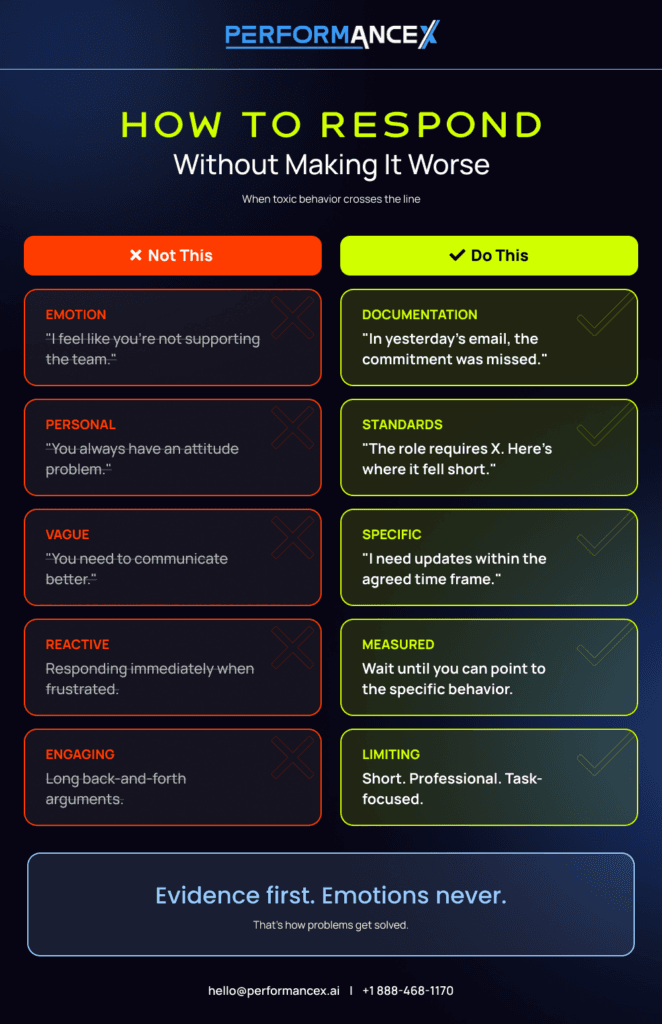
When someone slows down work or fails to meet the standards of their role, respond with clarity and evidence, not emotion. The goal is simple: keep work moving and make expectations unmistakable.
Focus on documented behavior to deal with toxic coworkers in practice. Here’s how to respond when behavior needs correction:
- Stay anchored to documented behavior: Refer to what was written or said, not how it made you feel. “In yesterday’s email, the commitment was missed,” is stronger than “I feel like you’re not supporting the team.”
- Keep conversations focused on work standards: State what the role requires and where the behavior fell short. Avoid personal interpretations. Expectations should be tied to responsibilities, not personalities. Professional boundary setting at work protects your focus.
- Set boundaries that protect execution: If an employee’s behavior interferes with your ability to deliver, say so directly. “I need updates within the agreed time frame so I can finish my part of the work” is clear, factual, and actionable.
- Avoid reactive responses: Respond only after you can clearly identify the actual message, missed commitment, or behavior. Reacting emotionally creates more conflict and gives the other person room to argue about tone instead of performance.
- Limit interactions that slow down the work: If someone consistently creates friction, keep exchanges focused on tasks, deadlines, and decisions. Short, professional communication prevents them from pulling you into unproductive back-and-forth.
How you respond matters as much as whether you respond. When every conversation is grounded in documented behavior and clear expectations, there’s no room for opinions to derail it. You protect your own output, and you protect the team from getting dragged into unnecessary conflict.
When Documented Behavior Needs Leadership Action
You’ve given direct feedback. The behavior hasn’t changed. Now what?
Take it to leadership.
The question is not whether to speak up, but how to make sure something actually happens.
Clear thresholds and documentation remove the guesswork. This is how to deal with toxic coworkers when direct feedback fails: you know when to act, and you have the evidence to back it up.
Know When to Involve HR
Employees and managers need to know exactly when to take behavior up the chain.
Any conduct that clearly violates company expectations or law should be reported to HR or leadership immediately. When harmful behavior begins to affect others on the team, it is time to involve a manager or HR so the concern can be addressed.
Managerial and HR Responsibility
Toxic behavior lands on a manager’s desk before it lands anywhere else. Your job is to take it seriously and act. Ignoring it or hoping it resolves itself only makes it worse.
A 2024 survey found 74% of workers felt their managers could have done more to prevent workplace toxic behavior. Leadership and coaching methods determine whether signs of toxic behavior are addressed or allowed to persist.
Formal Follow-Ups
Managers cannot act without facts. Give them clear documentation: what happened, when, and what was said. If the behavior continues or escalates, leadership may need to protect the team while the situation is addressed.
Here’s the real test of your culture: not whether problems show up, but how fast you deal with them when they do. When factual reports are treated as a normal part of work, rather than a last resort, problems are handled before they escalate.
How Leadership Can Prevent Toxicity From Taking Root
Leaders who understand how to deal with toxic coworkers act early and set clear expectations.
When you respond quickly to behaviors that damage teamwork or slow execution, you stop problems before they spread. Lead decisively so that harmful behavior never becomes part of how your team works. Effective solutions to toxic work environments require decisive leadership action.
Model Expectations
Managing toxic coworkers effectively starts at the top.
Leadership’s actions have the strongest influence on whether professional standards are upheld.
To prevent harmful behavior from taking hold, you must model the standard of communication and follow through with what you expect from others.
A manager who dismisses concerns or excuses a high performer’s unprofessional behavior because of their output signals that results matter more than how people work together.
Harmful behavior forces leaders to spend time managing preventable conflict instead of moving the company forward.
Leaders must reinforce the expectations set for every role and make it clear that high performance includes how people communicate and collaborate.
Address Toxic Employee Signs in Leadership Blind Spots
Toxic behavior thrives in blind spots. If you’re not seeing what happens in emails, Slack, and meetings every day, you’re not seeing the whole picture. Strong leaders don’t guess. They look at the evidence.
A survey done by the American Psychological Association noted that 52% of workers who reported toxic work environments experienced a decline in mental health. Strong leaders consistently seek feedback and actively scan for problems within the culture. Staying engaged helps you reduce the likelihood that toxic behaviors will go unnoticed.
Consistently ask, “What am I missing, and who can give me the context I do not see?” You can do this through clear communication channels, direct conversations, and tools that reveal real work behavior.
PerformanceX shows you the behaviors you miss across messages, calls, and meetings. When employees see that you are paying attention, they speak up earlier, and problems are addressed before they grow. This proactive visibility distinguishes teams where small problems stay contained from teams where behavior worsens because no one notices early.
Swift and Fair Response to Incidents Reported by PerformanceX
You’ve read the playbook: document the behavior, set clear expectations, escalate when needed. But here’s the problem. By the time toxic behavior gets documented and reported, the damage is already spreading. Your best people are frustrated. Your clients are getting ignored. And you’re finding out about problems weeks or months after they started.
Knowing how to deal with toxic coworkers is the first step toward fixing the problem. But you can’t deal with what you can’t see.
PerformanceX gives you visibility into what’s actually happening across your organization, every single week.
Here’s how our AI works. PerformanceX connects to the tools your team already uses: email, Slack, Zoom, Teams, and recorded phone lines. Our AI reads all employee communication and identifies the behaviors that matter: who responds to clients promptly, who assists teammates, who fulfills work commitments, who creates bottlenecks, who blames others, and who takes credit for work they didn’t do.
Every Monday morning, you receive a report. Not a dashboard you have to dig through. A report with names, quotes, and timestamps. You see exactly what happened and where expectations were not met.
Employees receive their own scorecard, which includes wins, areas for improvement, and specific examples. Managers see the whole picture across their team.
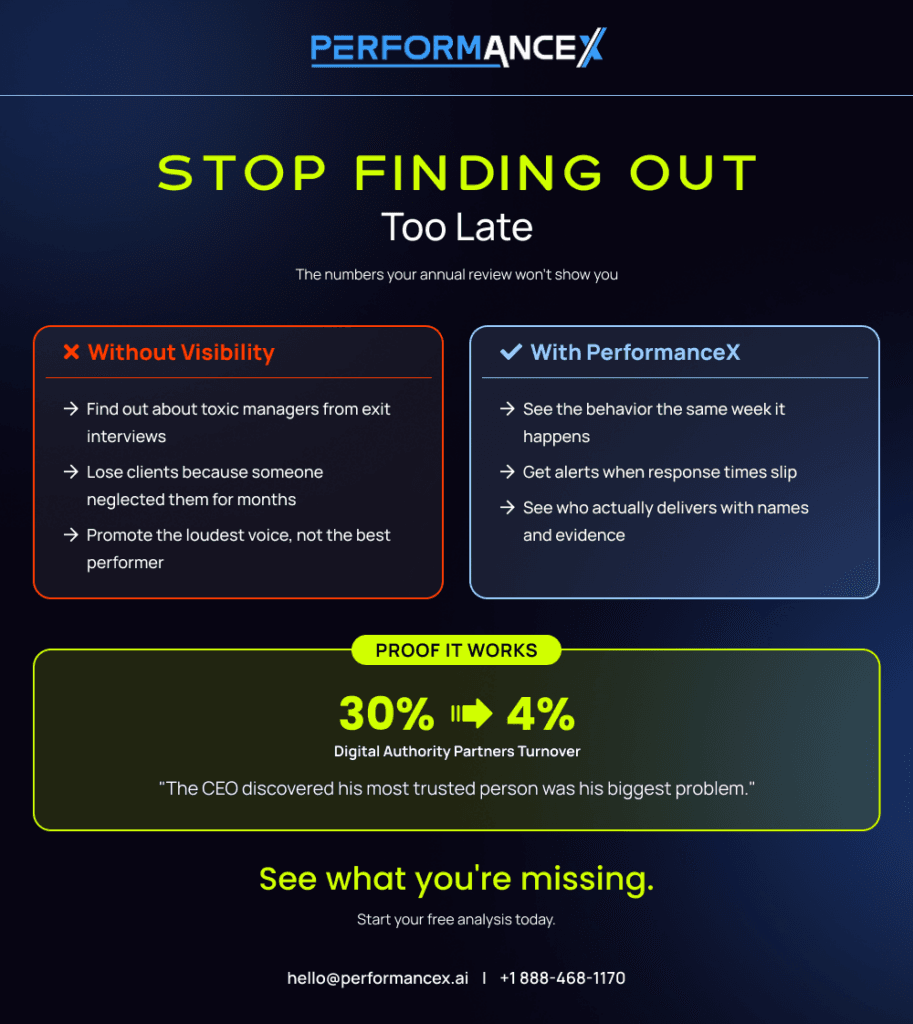
When toxic behavior appears, you typically notice it the same week it occurs. A hostile message to a teammate. A client’s email that sat unanswered for three days. A pattern of blame-shifting in project threads. PerformanceX surfaces it with evidence, so you can act before the problem spreads.
This is what changes when you have the visibility only PerformanceX can offer:
- You stop finding out about toxic managers from exit interviews.
- You stop losing clients because someone neglected the relationship for months.
- You stop promoting the loudest voice in the room while the quiet top performers go unrecognized.
The best advice on how to deal with toxic coworkers will always come back to documentation, clear expectations, and fast action.
PerformanceX makes all three possible by showing you what’s really happening in day-to-day work, not once a year, but every single week.”
Protect Performance and Learn How To Deal With Toxic Coworkers
Knowing how to deal with toxic coworkers comes down to three key steps: recognizing the behavior, documenting it, and taking action before it spreads.
The problem is visibility. Most leaders discover toxic employees through exit interviews, client complaints, or Glassdoor reviews. By then, the damage is done.
This article gave you the playbook.
- Recognize the warning signs: blame-shifting, credit theft, passive resistance, and client neglect.
- Respond with documented evidence, not emotion.
- Escalate when direct feedback doesn’t work. And hold leadership accountable for acting fast.
But the playbook only works if you can see what’s happening.
PerformanceX gives you that visibility. Every Monday, you get a report showing exactly who delivered and who didn’t. Names, quotes, timestamps. No guesswork. No politics. Just evidence.
Your best people deserve a culture where toxic behavior is caught and addressed, not ignored until they quit. That’s how to deal with toxic coworkers for good. Start your free analysis now.